If you have searched for a free non-VoIP phone number, you have probably already tried Google Voice, TextNow, or a free SMS receiving site — and hit a wall. The app you were trying to verify said the number is not accepted, or the code never arrived. That is because platforms like WhatsApp, Telegram, Gmail, and most other services now actively filter out VoIP numbers and only accept codes sent to real mobile carrier lines.
This guide explains what a non-VoIP number actually is, why the difference matters, whether a completely free option exists, and how to get a real non-VoIP number at the lowest cost when you need one for verification. No filler. Just the honest answer.
What Is a Non-VoIP Phone Number?
To understand what a non-VoIP number is, it helps to understand what VoIP means. A VoIP phone number is one that routes calls and SMS messages over the internet rather than through a traditional mobile carrier network. Google Voice, TextNow, Hushed, TextFree, and 2ndLine are all VoIP services. The number looks identical to any other phone number, but when a platform performs a carrier lookup, it sees that the number is linked to an internet-based provider rather than a real mobile carrier.
A non-VoIP number is the opposite: a number assigned by a real mobile network carrier — AT&T, T-Mobile, Verizon, and similar networks. These numbers originate from carrier infrastructure, and when a platform checks the carrier type, they pass. Most personal SIM cards are non-VoIP numbers. The key distinction is the carrier type recorded in the number lookup database, not anything visible in the number itself.
| VoIP numbers: Issued by internet-based services. Cheap or free to create. Blocked by most verification systems on major platforms. Examples: Google Voice, TextNow, Hushed, 2ndLine, Skype numbers. |
| Non-VoIP numbers: Issued by real mobile carriers. Tied to physical or virtual SIM infrastructure. Accepted by verification systems on all major platforms. Examples: any standard SIM card number, TextVerify carrier numbers. |
The distinction matters entirely because of how platforms check numbers during SMS verification. They do not check whether your number is free or paid — they check whether it comes from a real carrier. A VoIP number from a $5/month service is blocked just as reliably as one from a free service.
Why Apps Block VoIP Numbers
Platforms do not block VoIP numbers arbitrarily. There are concrete reasons, and understanding them explains why no workaround will make a VoIP number pass a carrier-type check.
- VoIP numbers scale instantly. Someone can create thousands of VoIP numbers programmatically in minutes. If platforms accepted VoIP numbers for verification, bot operators could create unlimited accounts with no friction. Real carrier numbers require actual SIM cards or carrier provisioning, which is slower and more expensive at scale.
- VoIP providers do not enforce identity. Most VoIP services require no government ID to obtain a number. Real carrier SIM cards in many countries require some form of identity registration. Carrier numbers carry a higher inherent accountability than internet numbers.
- VoIP number pools are known and catalogued. Number lookup databases (like Twilio Lookup, Neustar, and similar services) maintain records of which number ranges belong to VoIP providers. Platforms query these databases in real time when a number is submitted. There is no reliable way to make a VoIP number appear as a carrier number to these databases — the classification is at the infrastructure level, not the number level.
- Public SMS pools are burned. Numbers from shared public SMS sites appear on millions of account registrations. Platforms blocklist entire number ranges from these pools. Even if a code is sent, it is readable by anyone who visits the public inbox page.
Do Truly Free Non-VoIP Numbers Exist?
This is the honest section. The short answer is: not in any practical, repeatable way for SMS verification.
Here is a breakdown of the most common options people try:
| Google Voice (free). VoIP. Blocked by most major platforms during SMS verification. Google Voice’s own carrier lookup returns it as a VoIP number. Not a workaround. |
| TextNow / TextFree (free). VoIP. Same result. These services use number ranges owned by VoIP infrastructure providers. Blocked at carrier-type check. |
| Free public SMS sites (receive-smss.com and similar). Shared public number pools. Many numbers already blocklisted. No privacy — anyone can read your verification code in real time. |
| Using a friend or family member’s real SIM. Technically non-VoIP and it will work. But this links their real personal number to your account, exposes them to account recovery access, and is not a scalable or private solution. |
| Buying a prepaid SIM card. This is a real non-VoIP number. It works. But a physical SIM costs more than a temporary verification number from TextVerify, requires visiting a store, and permanently links a real number to your account rather than a one-time verification number. |
The practical conclusion: if you need a non-VoIP number for SMS verification without using your personal SIM, a low-cost temporary carrier number from TextVerify.io is the closest thing to “free” that actually works. The cost per verification is typically a fraction of what a prepaid SIM costs, there is no physical SIM to manage, and the inbox is private.
How to Get One That Actually Works
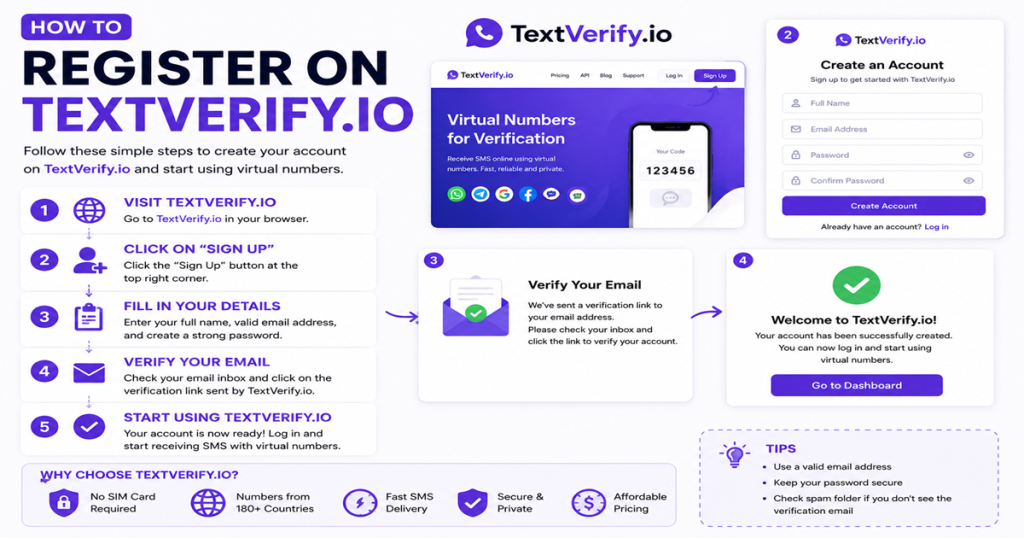
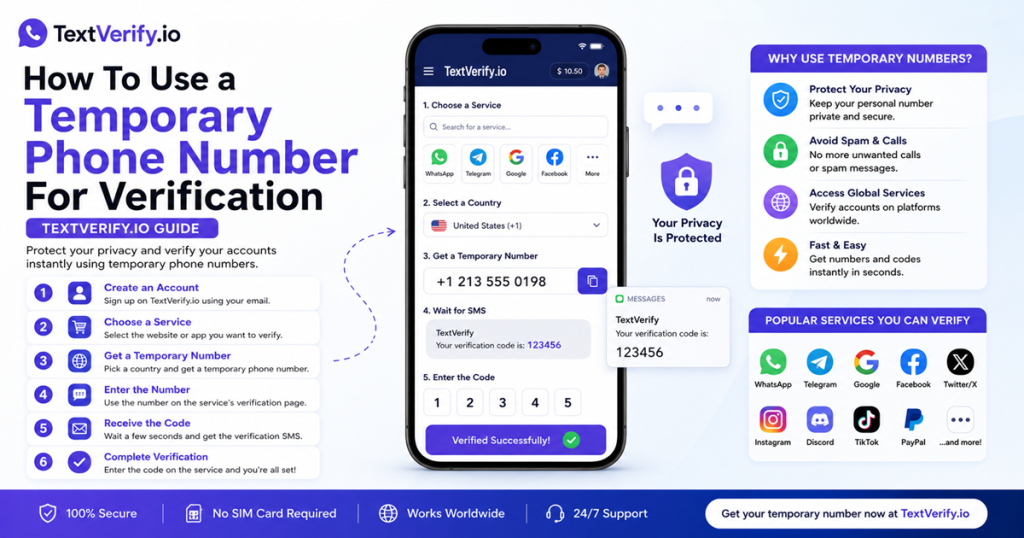
Here is the step-by-step process to get a real non-VoIP number from TextVerify for SMS verification:
Common Mistakes to Avoid
- Assuming all virtual numbers are VoIP. They are not. VoIP refers specifically to numbers routed over the internet. TextVerify numbers come from real carrier infrastructure. The distinction is in the originating network, not in the concept of a virtual or temporary number.
- Trying free VoIP services expecting them to work. Google Voice, TextNow, and similar services are fast and easy, but they will not get past a carrier-type check. Platforms have been blocking these for years. No setting or workaround changes the carrier classification of a VoIP number.
- Using a public inbox for sensitive accounts. If anyone can view the inbox, anyone can read your verification code. A public SMS site might deliver the code, but anyone who visits the page can see it too. For any account that matters to you, use a private inbox.
- Reusing the same number across many accounts on the same platform. Most platforms limit how many accounts can verify against the same phone number. After a certain threshold, the number is rejected. Use a separate number for each account on the same platform.
- Waiting too long to enter the code. Verification codes expire, typically within five to ten minutes. Have the TextVerify inbox open in a separate tab before you trigger the verification request, so you can copy the code immediately when it arrives.
- Buying credits for a VoIP service and expecting a non-VoIP result. Paying for a TextNow premium plan or a Google Voice subscription does not change the carrier type of the number. VoIP stays VoIP regardless of the pricing tier.
Frequently Asked Questions
Bottom line
A completely free non-VoIP number does not exist in any practical form. Every free option — Google Voice, TextNow, public SMS sites — is VoIP and will be blocked by major platforms. The lowest-cost working solution is a temporary carrier number from TextVerify.io: real carrier infrastructure, private inbox, no subscription, charged only when an SMS is successfully delivered. It is not free, but it is the option that actually works.
TextVerify.io
📱 Get a Real Non-VoIP Number Now
Real US carrier number · Private inbox · No subscription
Get Started on TextVerify.io →