Payoneer is a global payment platform used by freelancers, online sellers, and businesses to send and receive money across borders. It supports payments from marketplaces like Upwork, Fiverr, Amazon, and eBay, and allows users to withdraw funds to local bank accounts in over 190 countries. Because Payoneer handles cross-border financial transactions and operates under financial regulations in multiple jurisdictions, it requires phone number verification as part of its account setup and ongoing security process.
When you register for Payoneer, the platform sends a one-time SMS code to your phone number as part of account verification. Payoneer performs a carrier-type check before dispatching any code — numbers identified as VoIP are blocked at this step. To receive Payoneer’s SMS without using your personal number, TextVerify.io provides real non-VoIP US carrier numbers with private inboxes. Enter the number, receive the code privately, confirm it in Payoneer, and your account creation proceeds.
Why Payoneer Requires Phone Verification
Payoneer is regulated as a money transmitter and payment institution in multiple jurisdictions, including the US, EU, UK, Hong Kong, and Japan. Phone verification is a required step in its compliance and security framework for several reasons:
| Account registration. Payoneer requires a phone number during sign-up and sends a one-time SMS verification code. Account creation cannot be completed until the code is confirmed. This step applies to all new registrations, whether as an individual freelancer, company, or marketplace seller. |
| Identity verification (KYC). As a regulated payment institution, Payoneer must verify the identity of its users. Phone verification is the first layer of this process. Payoneer also requires a government-issued ID, proof of address, and in some cases additional business documents as part of its full KYC process. The phone step must be completed before KYC documents can be submitted. |
| Two-factor authentication on logins. Payoneer uses SMS-based two-factor authentication to secure account logins. When you sign in from a new device or browser, Payoneer sends a verification code to the registered phone number. Without a reachable number, login is blocked until the step is completed or alternative recovery is used. |
| Withdrawal and payment approvals. For high-value withdrawals or when sending payments to new recipients, Payoneer may request an additional SMS verification step. |
Payoneer validates the carrier type of submitted phone numbers before sending any SMS. VoIP numbers are identified and rejected instantly. TextVerify numbers are provisioned from real US carrier infrastructure and pass this validation.
What Does Not Work
These commonly attempted options fail at Payoneer’s phone verification step:
| Google Voice. VoIP. Payoneer’s carrier check identifies Google Voice and rejects it before any SMS is dispatched. This is among the most commonly tried workarounds for Payoneer and it fails at the carrier validation step. |
| TextNow, Hushed, 2ndLine, TextFree. All VoIP. These app-based phone services route over internet infrastructure rather than real carrier networks. Payoneer, operating as a regulated global payment platform, applies strict carrier validation and blocks all VoIP numbers before any verification code is sent. |
| Free public SMS receiving websites. Numbers from public SMS sites are blocklisted by Payoneer. These sites also display all incoming messages publicly, meaning your Payoneer verification code would be visible to anyone. Payoneer blocks these numbers proactively. |
| A number already used on another Payoneer account. Payoneer ties phone numbers to accounts as part of its identity system. A number previously associated with a Payoneer account cannot be reused for a new registration. Use a fresh TextVerify number each time. |
| Skipping the phone step entirely. Payoneer’s registration flow does not allow skipping the phone verification step. The account cannot submit KYC documents, connect to a marketplace, or receive payments until phone verification is completed. |
TextVerify.io numbers originate from real US mobile carrier lines. They pass Payoneer’s carrier-type check, and the verification code arrives in a private inbox that only your TextVerify account can access.
Step-by-Step Guide
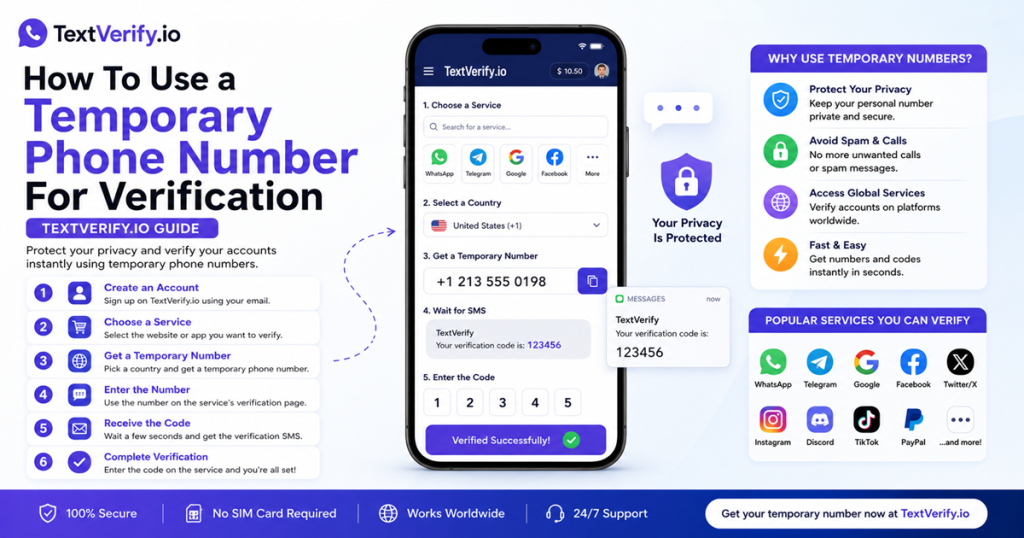
Here is how to complete Payoneer’s phone verification using a non-VoIP carrier number:
Common Mistakes to Avoid
- Using a VoIP number. Payoneer is a global regulated payment platform with strict carrier validation. Google Voice, TextNow, Hushed, and all VoIP services are rejected before any code is dispatched. Only a real carrier number from TextVerify passes Payoneer’s check.
- Assuming phone verification completes the full registration. Payoneer’s registration process includes multiple steps: phone verification, identity document upload, and account review. Phone verification only allows you to proceed with the form — the account is not active until Payoneer approves your submitted documents, which can take one to three business days.
- Using a number already registered to another Payoneer account. Payoneer ties phone numbers to accounts. A number previously used for Payoneer cannot be used again for a new registration. Use a fresh TextVerify number each time.
- Using a disposable number. Payoneer sends 2FA SMS codes on every new device login and for certain high-value transactions. A disposable number that expires after the initial verification will prevent you from logging in on a new device or browser. A rental number is strongly recommended.
- Not having your documents ready. After phone verification, Payoneer immediately asks you to upload identity documents. Have your passport or government ID scanned and ready before starting the registration flow to avoid losing session state mid-process.
- Selecting the wrong country code. TextVerify provides US (+1) numbers. Always select United States from Payoneer’s phone country dropdown before entering the number. A mismatched country code will route the SMS incorrectly and the code will never arrive.
Frequently Asked Questions
Bottom line
Payoneer’s phone verification requires a real non-VoIP carrier number — VoIP numbers are blocked before any code is sent. TextVerify.io provides real US carrier numbers that pass Payoneer’s check. Get the number, enter it during Payoneer registration, retrieve the SMS code from your private TextVerify inbox, and confirm it. Use a rental number so future 2FA logins and high-value transaction confirmations continue to work. Full Payoneer account activation requires separate KYC document verification, which takes one to three business days after submission.
TextVerify.io
🌎 Verify Your Payoneer Account Today
Real non-VoIP US numbers · Passes Payoneer’s carrier check · Private inbox
Get Started on TextVerify.io →