Facebook gives you two options during registration: sign up with your email address or sign up with your phone number. While email registration is technically available, Facebook increasingly pushes phone verification — and in many cases requires it to confirm your identity, unlock certain features, or complete account recovery. For users who want to keep their personal number off Facebook, or who need a separate account for a business page or project, this creates a practical problem.
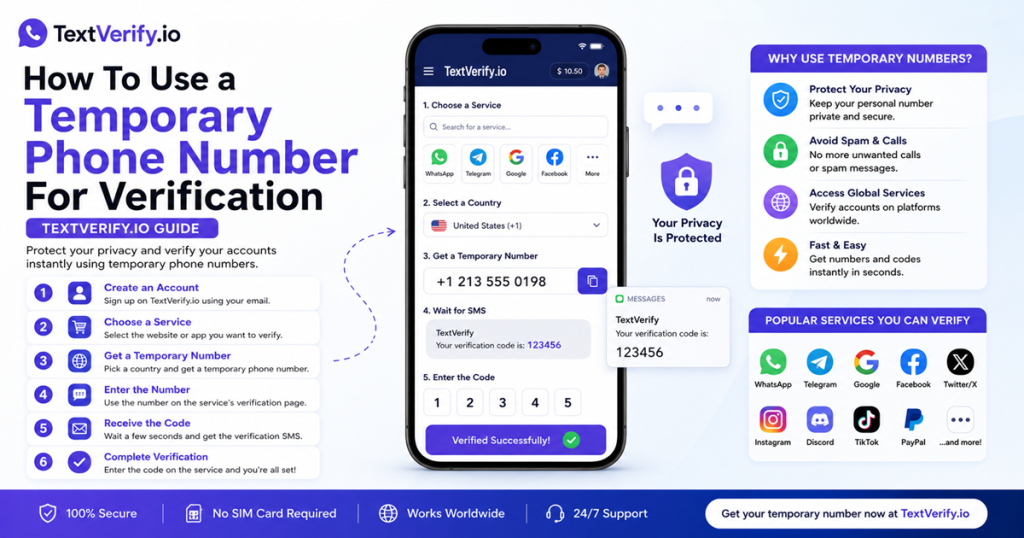
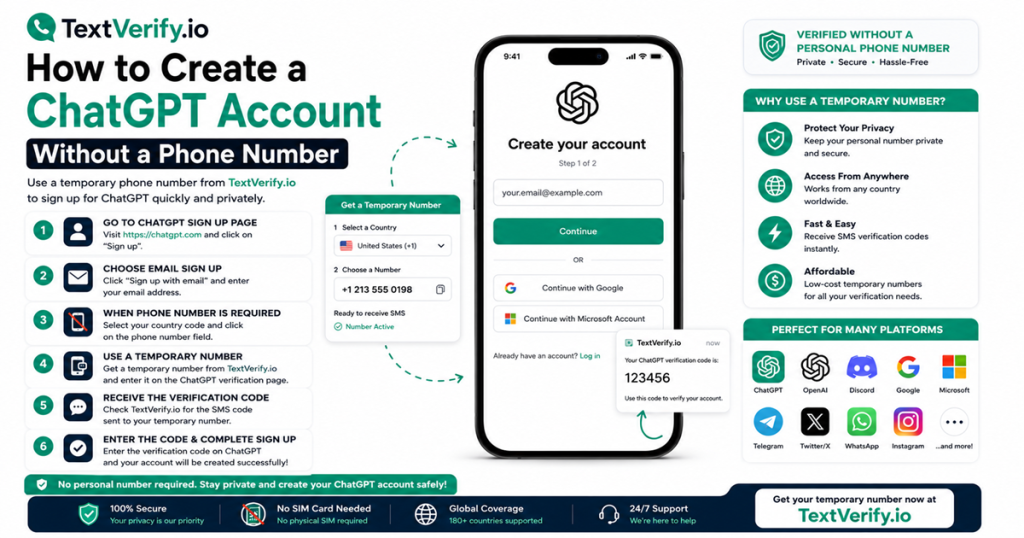
The straightforward solution is TextVerify.io, which provides real non-VoIP US phone numbers with a private SMS inbox. When Facebook asks for a phone number — whether during initial registration, identity confirmation, or two-factor authentication setup — you provide the TextVerify number, receive the code privately, and proceed. Your personal phone number is never associated with the account.
What Facebook Requires to Sign Up
Facebook’s registration form asks for your name, date of birth, gender, and either a phone number or email address. On the surface, email looks like a viable alternative to phone. In practice, Facebook’s verification behavior depends heavily on the situation:
| Email registration. Signing up with an email address is possible and can work for straightforward account creation. However, Facebook may prompt you to add and verify a phone number shortly after registration as part of identity confirmation or security setup. This prompt can appear during first login, when completing your profile, or when enabling two-factor authentication. |
| Phone registration. Signing up directly with a phone number triggers immediate SMS verification. Facebook sends a code to the number, and you must enter it to complete account creation. This path is more reliable and less likely to encounter follow-up identity challenges. |
| Identity checkpoints. Facebook may present an identity verification checkpoint at any time — during signup, on first login, or even weeks later. These checkpoints often require phone verification specifically, regardless of whether you registered with email. A TextVerify number resolves these prompts the same way it resolves initial signup verification. |
Regardless of which registration path you take, having a working phone number ready through TextVerify ensures you can get past any verification prompt Facebook presents.
Can You Skip the Phone Number on Facebook?
In some flows, yes — but not reliably, and it comes with trade-offs.
If you register with an email address and Facebook does not immediately require phone verification, you may be able to use the account with limited functionality. However, several things can trigger a forced phone verification later:
| Logging in from a new device. Facebook flags unfamiliar login patterns as suspicious. When it does, it often requires phone verification to confirm you are the account owner before allowing access. |
| Enabling two-factor authentication. Facebook’s 2FA setup requires a verified phone number. Without one, 2FA through SMS is unavailable, which leaves the account with weaker security. |
| Account recovery. If you lose access to your account email, a verified phone number is often the only recovery path. Accounts without a phone number are significantly harder to recover if something goes wrong. |
| Running ads or managing a Business Page. Facebook’s advertising and business tools often require a phone-verified account as part of their trust and compliance requirements. |
Rather than hoping phone verification does not come up, adding a TextVerify number upfront gives the account full functionality from the start and removes the risk of being locked out later at a critical moment.
What Does Not Work
These approaches are commonly tried and consistently fail against Facebook’s phone verification:
| Google Voice. VoIP. Facebook detects and rejects Google Voice numbers. The verification SMS is never sent and an error appears immediately upon submission. |
| TextNow / TextFree / Hushed and similar apps. All VoIP. Facebook performs carrier-type checks before sending any SMS. Internet-based number pools are identified and blocked before a code is dispatched. |
| Free public SMS receiving sites. These sites share their numbers across thousands of users. Facebook blocks most well-known shared number pools. On the rare occasion a code arrives, the number is publicly visible — meaning anyone could read the code and potentially take over the new account. |
| Reusing a number already on another Facebook account. Facebook links each phone number to one account. Attempting to verify with a number already registered to a different account results in an error or links the new registration to the existing profile. |
| Dismissing or closing the verification prompt. Facebook’s mandatory verification prompts cannot be dismissed. If the platform requires phone verification to proceed, closing the prompt typically blocks access to the account until verification is completed. |
TextVerify.io numbers are real US mobile carrier lines. They carry no VoIP classification and pass Facebook’s carrier-type check. The verification SMS arrives in your private inbox within seconds of Facebook sending it.
Step-by-Step Guide
Here is how to create a Facebook account (or verify an existing one) without using your personal phone number:
Frequently Asked Questions
Bottom line
Creating a Facebook account without a personal phone number requires one thing: a real carrier number that passes Facebook’s VoIP check and can receive an SMS. TextVerify.io provides exactly that. Enter the TextVerify number during signup or at any verification prompt, collect the code from your private inbox, and your account is confirmed — with your personal number staying out of it entirely.
TextVerify.io
👤 Create Your Facebook Account Today
Real non-VoIP US numbers · Instant SMS · Private inbox
Get Started on TextVerify.io →