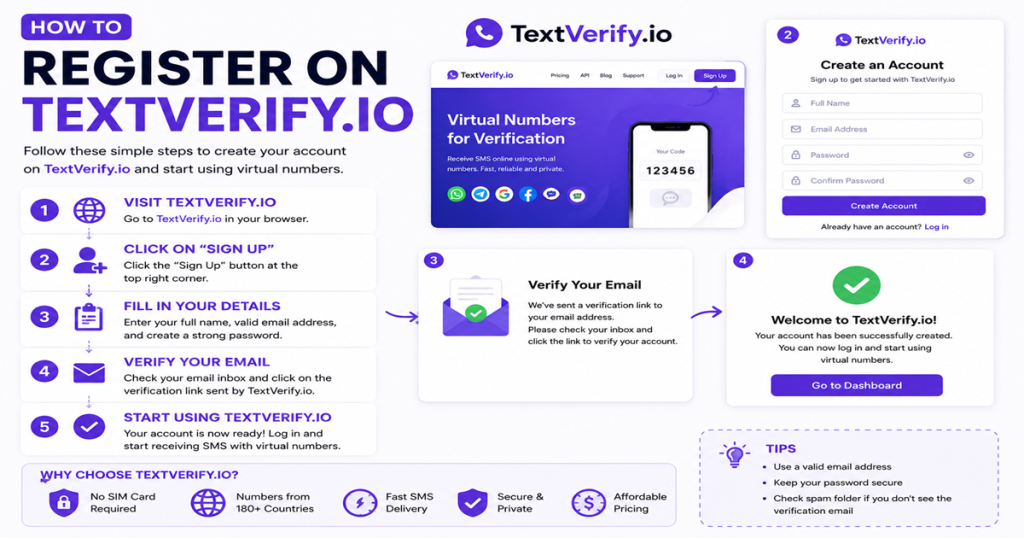
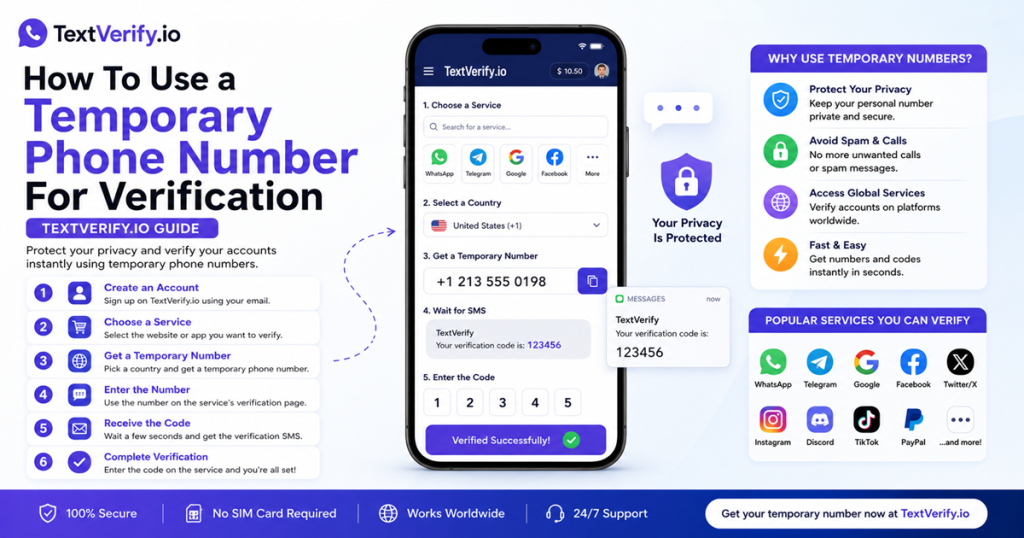
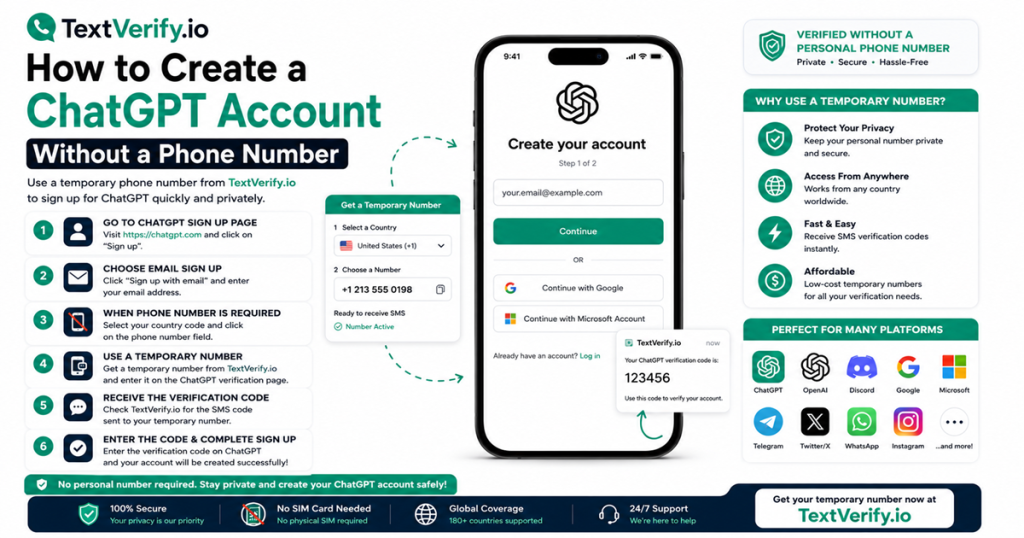
Amazon asks for phone verification in more situations than most people expect. It is not just a one-time step when creating an account. Amazon may send a verification code when you log in from a new device, when it detects unusual activity, when you place an order from an unfamiliar location, when you set up two-step verification, or when you access sensitive account settings. Each of these situations requires a phone number that actually receives SMS.
If you want to keep your personal number off your Amazon account — for privacy, because you use multiple accounts, or because you are creating an account and do not want your SIM attached to it — TextVerify.io provides a real non-VoIP US carrier number with a private inbox. You enter the TextVerify number when Amazon asks, collect the code in your private inbox, and complete verification. Your personal phone number stays out of it.
Why Amazon Asks for Phone Verification
Amazon uses phone verification more aggressively than most e-commerce platforms because a compromised Amazon account carries real financial risk — stored payment cards, order history, Prime membership, and in some cases AWS or seller account access. Here are the specific situations where Amazon’s verification prompt appears:
| New account creation. When you create a new Amazon account, you are asked to provide a phone number. Amazon sends an OTP to confirm the number before the account is activated. This is a mandatory step and cannot be skipped. |
| Sign-in from a new device or browser. Amazon tracks known devices associated with your account. When a sign-in comes from an unrecognized device, browser, or location, Amazon triggers a phone verification step before granting access. This can happen even on accounts that were created years ago. |
| Two-step verification (2SV). Amazon’s two-step verification sends an OTP via SMS every time you sign in. Setting up 2SV, or being prompted to verify during a 2SV-protected login, requires a number that reliably receives SMS. |
| Suspicious activity detection. If Amazon’s fraud system flags your account — due to an unusual order, a change in shipping address, or an IP mismatch — it may lock the account temporarily and require phone verification before restoring access. This can happen unexpectedly. |
| Seller account and AWS access. Amazon seller accounts and AWS accounts enforce phone verification as part of their security requirements. The verification applies to the core Amazon account that seller and AWS accounts are linked to. |
In all cases, Amazon performs a carrier-type check before sending the OTP. If the number is identified as VoIP, the code is not sent. TextVerify numbers originate from real US carrier infrastructure and pass this check.
What Does Not Work
These are the approaches people commonly try when looking to avoid using their personal number with Amazon:
| Google Voice. VoIP. Amazon’s carrier-type check identifies Google Voice numbers and blocks them before dispatching an OTP. The form returns an error or the OTP simply does not arrive. |
| TextNow, Hushed, 2ndLine. All VoIP. Internet-based numbers do not originate from carrier infrastructure. Amazon’s lookup identifies them and no OTP is dispatched. |
| Free public SMS receiving sites. Amazon has blocklisted the shared number pools from public SMS sites. These numbers appear across millions of account registrations. No OTP arrives, or if it does, the code is publicly visible to anyone on the site. |
| Skipping the verification step. Amazon does not offer a way to bypass phone verification once it has been triggered. New account creation cannot be completed, and locked accounts cannot be accessed until the OTP is entered. |
| A number already attached to too many Amazon accounts. Amazon limits how many accounts can be associated with the same phone number. A TextVerify number used on multiple Amazon accounts in succession may be rejected. Use a fresh number for each Amazon account. |
TextVerify.io numbers are sourced from real US mobile carrier lines. They are not classified as VoIP, pass Amazon’s carrier check, and deliver the OTP to a private inbox only you can access.
Step-by-Step Guide
Here is how to complete Amazon phone verification without using your personal number:
Common Mistakes to Avoid
- Using a VoIP number. Google Voice, TextNow, and similar services are blocked before Amazon sends any OTP. Only a real carrier number from TextVerify will pass Amazon’s carrier-type check.
- Not having the TextVerify inbox ready before triggering the OTP. Amazon’s OTPs expire quickly — typically within 10 minutes, sometimes less. Open the TextVerify inbox in a separate tab before you click “Send OTP,” so you can copy the code the moment it arrives.
- Using the same TextVerify number for multiple Amazon accounts. Amazon limits how many accounts can be associated with one phone number. If you need to create or verify multiple Amazon accounts, use a separate TextVerify number for each one.
- Enabling two-step verification with a disposable number. A disposable number receives one SMS and expires. If you enable 2SV on the account, you will need the same number to receive OTPs on every subsequent login. Use a rental number if you are setting up 2SV.
- Assuming the OTP only comes once. If Amazon does not receive a response within the time window, it may offer a “resend code” option. Each resend is a new SMS. As long as the TextVerify number is still active and assigned, it will receive resent codes too.
- Entering the number without the country code. Always select United States (+1) from the country dropdown before entering the TextVerify number. Amazon’s form requires the correct country prefix to route the SMS correctly.
Frequently Asked Questions
Bottom line
Amazon’s phone verification appears at account creation, new device logins, security checkpoints, and two-step verification prompts. VoIP numbers are blocked at every one of these steps. TextVerify.io provides a real US carrier number with a private inbox that passes Amazon’s check. Get the number ready before triggering the OTP, enter it when Amazon asks, copy the code privately, and verification is done — your personal phone number stays off your Amazon account entirely.