Baidu (百度) is a Chinese multinational technology company headquartered in Beijing, China, founded in 2000 by Robin Li (Li Yanhong) and Eric Xu. It is best known for operating China’s dominant search engine — Baidu Search — which holds approximately 60–70% of China’s search engine market share and processes billions of queries daily. Baidu is listed on the Nasdaq stock exchange under the ticker BIDU, making it one of the few major Chinese technology companies with a primary US listing. Beyond search, Baidu operates an extensive ecosystem of services: Baidu Netdisk (cloud storage), Baidu Maps (navigation), Baidu Translate, Baidu Tieba (forum community platform), Baidu Baike (Chinese-language encyclopedia), iQIYI (video streaming, now separately listed), and significant investments in artificial intelligence, autonomous driving through its Apollo project, and large language model development with ERNIE Bot. Baidu is considered one of the “BAT” companies — Baidu, Alibaba, and Tencent — that have historically dominated the Chinese internet industry.
Baidu requires phone number verification at account registration and uses it as the primary identity credential for the Baidu account ecosystem. A single Baidu account (百度账号) provides access to Baidu Search sign-in features, Baidu Netdisk cloud storage, Baidu Tieba, Baidu Maps, and other Baidu services. Baidu’s registration system supports international phone numbers including US numbers (+1), making it accessible to users outside China who want to access Baidu services. Baidu’s verification system performs a carrier check that blocks VoIP and internet-routed numbers before dispatching any OTP. If you want to register a Baidu account without your personal phone number — to access Baidu Netdisk cloud storage or other services without linking your personal contact details, to maintain privacy when accessing Chinese-language services, or to separate a Baidu account from your personal number — a real non-VoIP US carrier number from TextVerify.io passes Baidu’s carrier check and delivers the verification code to a private inbox only you can access.
Why Baidu Requires Phone Verification
Baidu’s phone verification requirement reflects both Chinese regulatory requirements and the platform’s role as a multi-service ecosystem:
| Chinese real-name registration regulations. Chinese internet platforms operating under Chinese jurisdiction are required to comply with real-name registration (网络实名制) regulations, which mandate that users register with verified identity information. Phone number verification is the primary mechanism Chinese platforms use to satisfy this requirement, since Chinese mobile SIM cards are issued against real identity documents (national ID card). This regulatory framework is a primary driver of Baidu’s mandatory phone verification, though the requirement also applies to users registering with international numbers. |
| Single account access to multiple Baidu services. A Baidu account is a unified identity credential that provides access to Baidu Search sign-in features, Baidu Netdisk (2TB free cloud storage), Baidu Tieba forums, Baidu Maps saved locations, Baidu Translate history, and other Baidu services through a single login. The phone number is the account recovery mechanism and the identity anchor for this ecosystem. Without phone verification, a compromised Baidu account would potentially expose multiple services simultaneously, making identity verification especially important. |
| Baidu Netdisk and cloud storage security. Baidu Netdisk (百度网盘) provides substantial free cloud storage and is widely used for storing personal documents, photos, videos, and backups. Accounts holding significant personal data require robust identity verification to protect stored files from unauthorized access. Phone verification supports two-factor authentication on Baidu accounts, adding a security layer for accounts used as personal cloud storage. |
| Preventing spam and content abuse on Baidu Tieba. Baidu Tieba (贴同) is one of China’s largest forum communities, with tens of thousands of topic-based boards covering every subject imaginable. Without phone verification, automated accounts could flood Tieba boards with spam, manipulate trending topics, or post harmful content at scale. Phone verification using real carrier numbers raises the barrier to creating throwaway posting accounts significantly. |
| AI and ERNIE Bot access control. Baidu has invested heavily in artificial intelligence and launched ERNIE Bot (文弟一言), its large language model assistant, as a major product. Access to ERNIE Bot and other Baidu AI services requires a verified Baidu account. Phone verification is the identity gate for accessing these AI services, ensuring usage can be attributed to accountable identities under Chinese AI content regulations. |
What Does Not Work
These alternatives fail at Baidu’s carrier validation step:
| Google Voice. VoIP. Baidu’s carrier check identifies internet-routed numbers and blocks them before dispatching any OTP. This check applies both to Chinese and international number registrations. |
| TextNow, Hushed, 2ndLine, Sideline, Burner. All VoIP. App-based virtual numbers route over the internet and are flagged at Baidu’s carrier check. These number ranges are well-documented as VoIP allocations in carrier databases. |
| Free public SMS receiver websites. Blocked by Baidu. Numbers from public online SMS inboxes are flagged, and using a shared inbox exposes your verification code publicly — a risk on a platform where your account provides access to cloud storage and multiple Baidu services. |
| Skipping verification. Phone verification is mandatory at Baidu account creation. There is no path to register without it. The account cannot be activated without completing phone verification with a number Baidu accepts. |
TextVerify.io numbers are provisioned from real US licensed telecom carrier infrastructure. They register in carrier databases as genuine mobile numbers, pass Baidu’s international carrier check, and deliver the OTP to a private inbox only you can access.
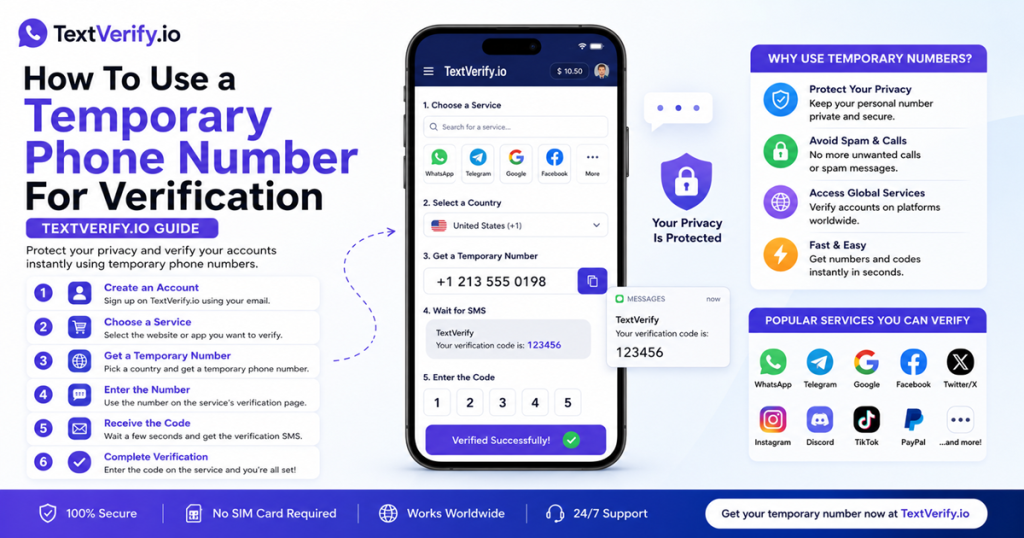
Step-by-Step Guide
Create a Baidu account without your personal phone number:
Common Mistakes to Avoid
- Using a VoIP number. Baidu’s carrier check blocks VoIP and internet-routed numbers before dispatching any OTP. This check applies to both Chinese and international number registrations. Only a real US carrier number from TextVerify passes consistently.
- Using a public SMS inbox. Baidu accounts provide access to Baidu Netdisk cloud storage and multiple services. A shared public inbox exposes your verification code to anyone online — a risk on a platform where your account controls stored files and service access.
- Not having your TextVerify inbox open before clicking Get verification code. Baidu OTPs expire within minutes. Have your inbox tab ready before submitting the number so you can copy and enter the code immediately when it arrives.
- Not selecting the international number option. Baidu’s registration form defaults to Chinese phone numbers (+86). Make sure to select the overseas/international number option and choose United States (+1) before entering your TextVerify number, or the number format will be rejected.
- Not updating the number before the rental expires. Baidu uses the registered phone number for account recovery and security verification. Update it in your Baidu account settings before the TextVerify rental expires to maintain access to your Baidu Netdisk files and account.
Frequently Asked Questions
Bottom line
Baidu requires phone verification at account creation and blocks VoIP numbers before sending any OTP. TextVerify.io provides real US carrier numbers that pass this check for international registration. Enter the number, select United States (+1) from the country code list, copy the OTP from your private inbox, and your Baidu account gives you access to Baidu Netdisk, Tieba, ERNIE Bot, and the full Baidu service ecosystem — with your personal number kept off the platform entirely.
TextVerify.io
🔍 Verify Baidu Without Your Personal Number
Real non-VoIP US numbers · Passes Baidu’s international carrier check · Private inbox only you can access
Get Started on TextVerify.io →