Binance is the world’s largest cryptocurrency exchange by trading volume. Founded in 2017, Binance offers spot trading, futures and derivatives trading, staking, savings products, an NFT marketplace, and a broad range of crypto financial services. Users can trade hundreds of cryptocurrency pairs including Bitcoin, Ethereum, BNB, and thousands of altcoins. Binance also operates Binance.US, a separate exchange for US-based users that complies with US financial regulations. The platform supports deposits and withdrawals via bank transfer, credit and debit cards, and peer-to-peer (P2P) trading. Binance offers tiered fee structures based on trading volume and BNB holdings, and its native BNB token provides fee discounts across the platform. Binance operates globally with localized versions in multiple jurisdictions, though availability varies by country due to regulatory requirements.
Binance requires phone number verification as part of its account registration and KYC (Know Your Customer) process. As a global cryptocurrency exchange handling billions of dollars in daily trading volume and processing real fiat and crypto withdrawals, Binance is required by financial regulators in its licensed jurisdictions to verify user identity before enabling withdrawals and certain trading features. Binance’s verification system sends a one-time code by SMS and performs a carrier check that rejects VoIP and internet-routed numbers. If you want to register on Binance without your personal carrier number — to keep your contact details private or manage the account separately — a real non-VoIP US carrier number from TextVerify.io passes Binance’s carrier check and delivers the verification code to a private inbox only you can access.
Why Binance Requires Phone Verification
Binance uses phone verification as part of its global AML and financial compliance infrastructure:
| Global AML compliance and KYC requirements. Binance operates under financial licenses and regulatory oversight in multiple jurisdictions that require Anti-Money Laundering (AML) and Know Your Customer (KYC) compliance. Phone verification is a mandatory component of Binance’s KYC process alongside government ID submission and facial verification. Under Binance’s tiered verification system, phone verification is required at the most basic account level, while full trading and withdrawal features require completing higher KYC tiers with identity document review. |
| Withdrawal security for crypto and fiat funds. Binance processes billions of dollars in cryptocurrency withdrawals daily. Phone verification is part of the withdrawal security layer that ensures withdrawal requests are authorized by the verified account holder. Withdrawal addresses must be whitelisted on Binance, and adding new withdrawal addresses requires SMS or authenticator confirmation from the registered number, reducing the risk of unauthorized fund transfers from compromised accounts. |
| Two-factor authentication for trading and account security. Binance strongly recommends and in many cases requires two-factor authentication for account logins and sensitive actions. The platform supports SMS-based 2FA and authenticator app 2FA (Google Authenticator, Binance Authenticator). Phone verification at registration establishes the number used for SMS 2FA, adding a login security layer beyond email and password that protects trading accounts and crypto holdings. |
| Preventing multi-account bonus abuse and market manipulation. Binance offers new user bonuses, trading competitions, and staking rewards. Without phone verification as a registration barrier, the same user could create multiple accounts to claim bonuses repeatedly or participate in trading competitions unfairly. Phone verification using real carrier numbers raises the barrier to multi-account creation and helps maintain fair platform conditions for all users. |
| Fiat on-ramp and payment security. Binance supports fiat deposits via bank transfer and card payments, and fiat withdrawals to bank accounts. Processing fiat transactions alongside cryptocurrency requires financial institution-grade identity verification. Phone verification is part of the account identity layer that secures fiat transaction authorization and complies with payment processing requirements in jurisdictions where Binance offers fiat services. |
What Does Not Work
These alternatives fail at Binance’s carrier validation step:
| Google Voice. VoIP. Binance’s carrier check identifies internet-routed numbers and blocks them before dispatching any OTP. As a global financial platform, Binance applies strict carrier validation and Google Voice is excluded. |
| TextNow, Hushed, 2ndLine, Sideline, Burner. All VoIP. App-based virtual numbers route over the internet and are flagged at Binance’s carrier check. These services’ number ranges are well-known VoIP allocations excluded by financial exchanges under their AML compliance requirements. |
| Free public SMS receiver websites. Blocked by Binance. Numbers from shared public inboxes are flagged, and using a public inbox exposes your verification code to anyone online — a critical risk on an account holding cryptocurrency and linked to bank or card payment methods. |
| Skipping phone verification. Phone verification is mandatory for Binance account creation. Accounts without a verified phone number cannot access trading features, withdrawals, or the platform’s financial services. |
TextVerify.io numbers are provisioned from real US licensed telecom carrier infrastructure. They register in carrier databases as genuine mobile numbers, pass Binance’s check, and deliver the OTP to a private inbox only you can access.
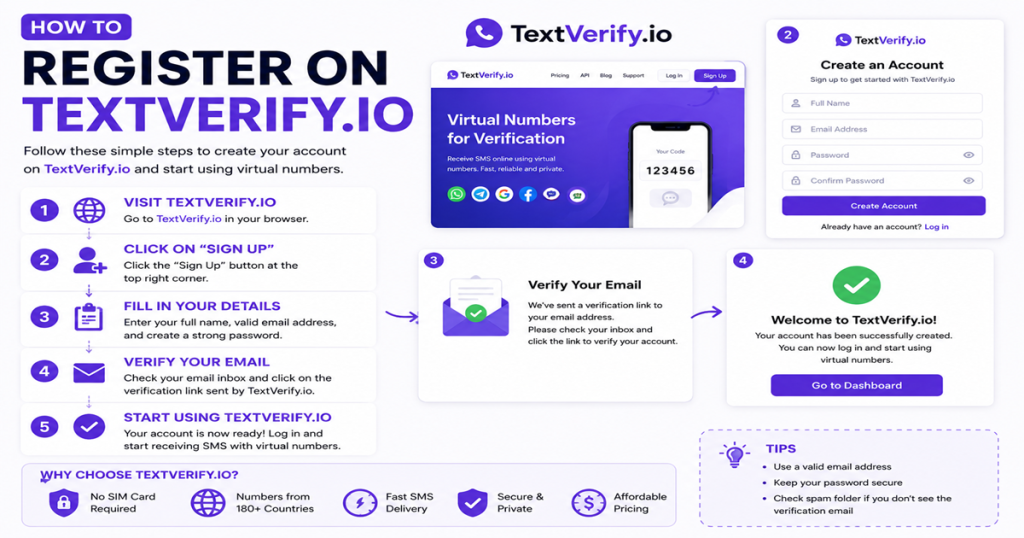
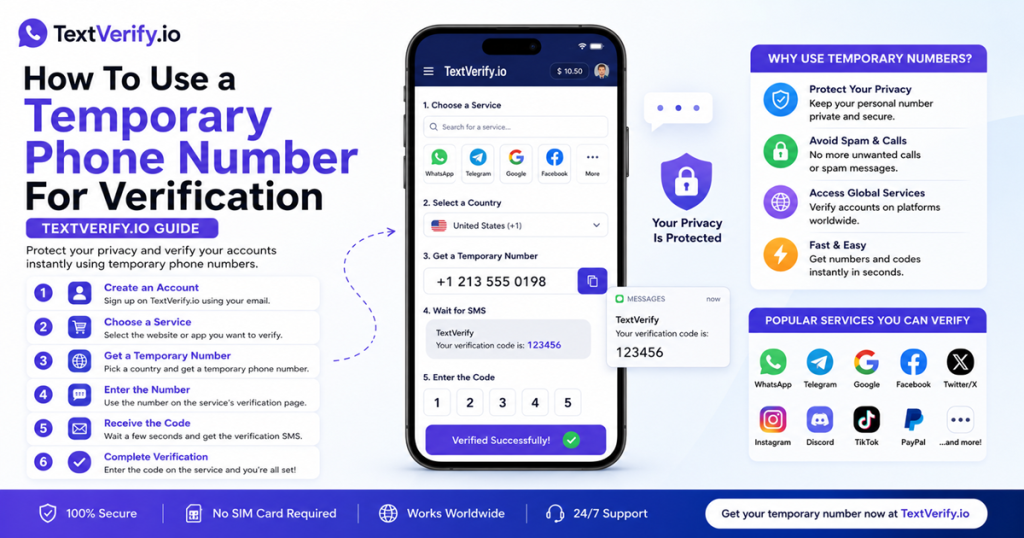
Step-by-Step Guide
Create a Binance account without your personal phone number:
Common Mistakes to Avoid
- Using a VoIP number. Binance’s carrier check blocks VoIP and internet-routed numbers before dispatching any OTP. Only a real US carrier number from TextVerify passes consistently.
- Using a public SMS inbox. A shared public inbox exposes your Binance verification code to anyone online — a critical risk on an account holding cryptocurrency and linked to payment methods.
- Not switching to an authenticator app after registration. SMS 2FA is less secure than authenticator app 2FA because SIM-swap attacks can redirect SMS messages. After registration, switch Binance’s 2FA from SMS to the Binance Authenticator or Google Authenticator in security settings for stronger account protection.
- Assuming phone verification unlocks full trading and withdrawals. Binance uses a tiered KYC system. Phone verification enables basic account access, but full trading features and withdrawal limits require completing identity document verification. Submit your government ID and complete facial verification as prompted to unlock full account functionality.
- US users accessing binance.com instead of binance.us. Binance.com is not available to US residents. US users must register on Binance.US (binance.us), which is a separate entity compliant with US financial regulations and offers a subset of the features available on the global platform.
Frequently Asked Questions
Bottom line
Binance blocks VoIP numbers before sending any verification code. TextVerify.io provides real US carrier numbers that pass this check. Enter the TextVerify number at registration, copy the OTP from your private inbox, and your Binance account moves through verification — with your personal number kept entirely off the platform.
TextVerify.io
🪙 Verify Binance Without Your Personal Number
Real non-VoIP US numbers · Passes Binance’s carrier check · Private inbox only you can access
Get Started on TextVerify.io →